
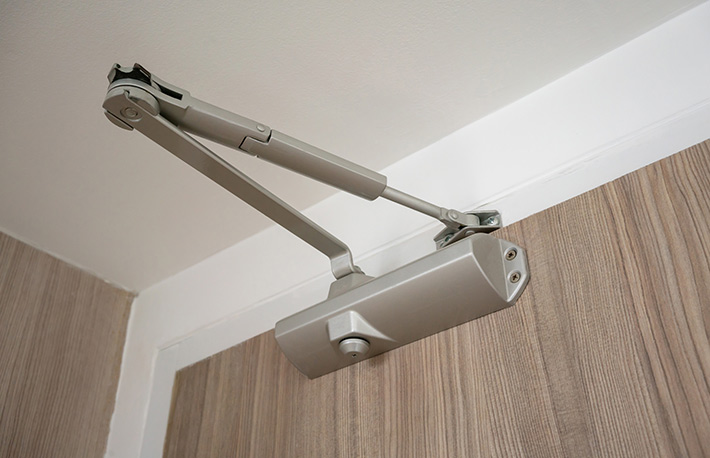
Door closers are something you tend not to notice until they start acting up. One week, the door shuts quietly. The next week, it slams hard enough to rattle the glass or drift shut and just sits there without latching. In a business, that turns into complaints, security worries, and sometimes a safety issue if people are getting their heels clipped.
The good news is that most common problems follow a short list of causes. Some are simple adjustments. Some are signs that the closer is worn out and needs to be replaced. The trick is knowing which is which before you spend time chasing your tail.
Door closers that slam or won’t latch: what’s really happening according to a locksmith.
A door closer is basically a hydraulic speed controller with a spring. The spring wants to pull the door shut. The hydraulic part controls how fast it moves. When the door slams, the spring is winning. When the door won’t latch, it usually means it’s losing energy near the end of its swing, the latch is misaligned, or something is dragging.
Most commercial closers have a few adjustment points that control different parts of the closing motion. The names vary by model, but the idea is consistent:
● One adjustment controls the main closing speed through most of the swing.
● Another controls the last few inches, the “latch” area, where the door needs a little extra push to click shut.
● Many also have a backcheck feature that helps cushion the door if someone throws it open too hard.
If the closer was working fine and suddenly isn’t, it’s worth looking at the door itself before you touch the closer. A closer can only do its job if the door swings freely. A door that binds on the frame, rubs the floor, or fights a stiff hinge will behave like a closer problem even when the closer is fine.
Here are the most common causes behind the two big symptoms:
Slamming usually comes from closing speed set too fast, latch speed set too fast, or a closer that has lost its ability to dampen movement due to internal wear or fluid loss. Wind can make this look worse, especially on doors that open to the outside.
Failure to latch usually comes from a latch speed set too slowly, a door that is not swinging freely, a misaligned latch or strike, a door that is slightly out of square, or a closer that no longer has enough controlled power at the end of the swing.
What you can check before deciding on adjustment vs replacement
● Start with the swing. Open the door and let it move slowly by hand. If it feels rough, rubs, or sticks at one spot, fix that first. Closers hate friction.
● Look at the hinges. Loose screws, worn hinge pins, or a sagging door can cause the latch to shift out of alignment. That can make a closer seem weak when the real issue is the door position.
● Check the latch and strike. If the latch bolt hits the strike plate or drags, the door may bounce back instead of latching. That’s not a closer adjustment problem.
● Notice when it fails. If it latches sometimes but not when the HVAC kicks on or when it’s windy, you may be dealing with air pressure or wind resistance, not just speed settings.
● Adjust slowly, in small turns. Most closers respond to small changes. A tiny turn can make a big difference. Cranking screws hard is how people damage closers.
● Watch for oil. A closer body that’s damp with oil, especially around the spindle or adjustment area, is often a sign that the seals are failing.
● Listen and watch. A door that slams only in the last few inches points to a latch speed issue. A door that rushes the whole way points to the main speed. A door that closes fine but “pops” off the latch points to an alignment issue.
Once those basics are checked, an adjustment makes sense when the closer is otherwise healthy. If the door swings freely, the latch lines up, and the closer still can’t control the motion, you are likely looking at a worn unit.
A quick word on “leaking,” because this is where people get misled. Sometimes you will see a light film or a small smudge near an adjustment screw from years of dust and humidity. That alone does not always mean the closer is failing. What matters is whether you see active oil, wet streaking, or a closer that keeps getting worse even after adjustment.
If the hydraulic fluid is escaping, the closer loses control. It might start as a mild slam. A month later, it feels like the door is on a spring with no brakes.
There’s also a safety angle. A slamming door is more than annoying. It can damage the door, loosen hardware, crack glass, and create pinch hazards. A door that won’t latch is a security issue and can also cause fire door compliance problems in some settings. If a door is supposed to self-close and latch, it needs to do that reliably.
When replacement is the smarter move
If you’ve carefully adjusted the speeds and the problem returns quickly, replacement is often the best use of time. The same goes for closers that are visibly leaking, those with inconsistent behavior (fine one day, wild the next), or units that cannot be set to close smoothly without either slamming or stalling. At that point, the internal seals and valves are not performing consistently.
A new closer, sized correctly for the door and installed at the right angle, usually solves the issue in a way that repeated tweaking never will.
Door Closer Repair and Locksmith Services You Can Trust
If you want the door fixed without guesswork and without disrupting your day, Action Locksmith Inc. can inspect the closer, confirm whether an adjustment will hold or whether replacement makes more sense, and get the door closing smoothly and latching reliably again. Our locksmith services are backed by 35+ years of hard work and dedication to home and business owners throughout Southeast Michigan.Call today to schedule service.